
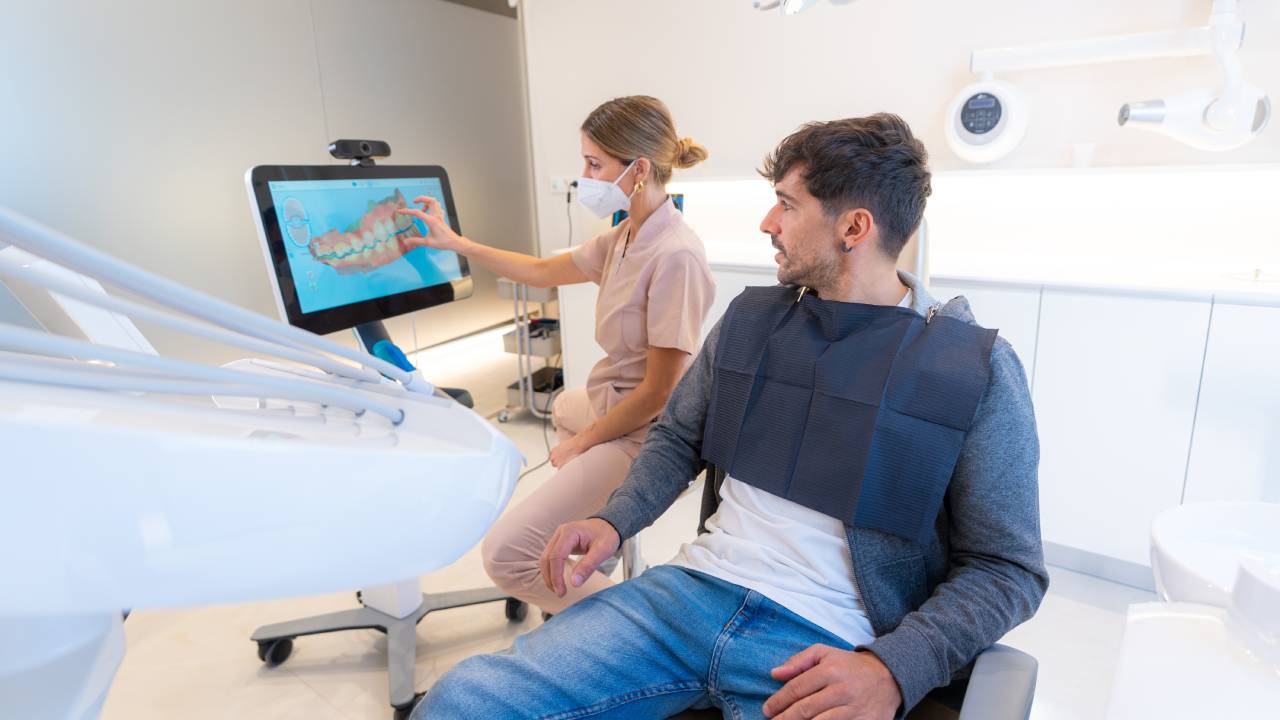
Dentistry in 2025 looks almost nothing like it did twenty years ago, and understanding how modern dentistry has changed helps you make better decisions about your own care. The procedures patients once dreaded, the appointments that consumed entire workdays, and the guesswork that led to ill-fitting restorations have been systematically replaced by faster, more precise, and more comfortable alternatives.
A 2022 report from the American Dental Association found that practices adopting digital workflows, including 3D imaging and CAD/CAM milling, grew from under 10% of U.S. offices in 2005 to more than 40% by 2021. That shift happened faster than almost any other area of outpatient healthcare. What drove it wasn't novelty. It was patient demand for shorter appointments, fewer referrals, and less discomfort. The result is a version of dentistry that prioritizes precision over convention, and your time over the practice's convenience.
This article covers the most consequential changes: pain management, digital technology, materials, minimally invasive techniques, and prevention. Each section explains the mechanism, names the evidence, and tells you exactly what to ask at your next appointment.
A 2022 ADA Health Policy Institute survey of more than 15,000 adults found that dental anxiety affects roughly 36% of the population, with 12% reporting extreme fear. The most common trigger isn't the drill itself. It's the memory of unexpected pain from a previous visit.
Modern anesthesia delivery has changed that calculation. Computer-controlled local anesthesia systems, often called the Wand, administer numbing agents at a regulated flow rate that eliminates the pressure and sting associated with traditional syringe injections. Combined with topical anesthetics applied before any needle contact, the onset is gradual and the discomfort is minimal. Sedation options, including nitrous oxide and oral conscious sedation, are now standard in full-service practices for patients who need them.
The practical result: procedures patients feared most, root canals, extractions, and implant placement, now routinely require nothing stronger than over-the-counter ibuprofen for recovery. If dental anxiety has kept you from booking an appointment, call the practice before you schedule and ask directly what sedation options are available. Don't assume the worst based on an experience from a decade ago.
A 2021 systematic review published in the Journal of Prosthetic Dentistry found that digital impressions produced statistically better marginal fit outcomes compared to traditional putty impressions across 23 clinical trials. That single finding captures the broader story: digital tools don't just make appointments faster, they produce better clinical results.
The technologies driving this shift include cone-beam CT scanning, intraoral cameras, and in-office milling systems. Cone-beam CT produces a three-dimensional image of your jaw, sinuses, and nerve pathways before any procedure begins. Intraoral cameras let the dentist show you exactly what they see on the tooth surface, in real time, rather than describing it from memory. Understanding what a dentist uses an intraoral camera for helps explain why this tool has become a baseline standard rather than a premium feature.
When you're evaluating a practice, ask two direct questions: Do you use digital X-rays? Do you have intraoral cameras? A practice with both is working with a substantially higher diagnostic baseline. The radiation from digital X-rays is also up to 90% lower than conventional film, according to the FDA, which matters if you have children who need imaging. The broader picture of what separates digital from conventional imaging is worth reviewing before your next appointment.
CAD/CAM technology allows a dentist to design, mill, and cement a permanent ceramic crown in a single appointment. A 2020 study in the Journal of Dentistry found that same-day CEREC crowns demonstrated equivalent five-year survival rates compared to lab-fabricated crowns. The clinical outcomes are the same. The difference is that you skip the temporary crown, the second appointment two weeks later, and the risk of the temporary coming loose in the meantime.
For a working adult in Charlotte who can't easily take two half-days off, this matters in a way that's hard to overstate. The full picture of what to expect with a single-visit restoration covers the process in detail. When you need a crown, ask directly whether the practice mills in-house.
A 2019 clinical study in the International Journal of Oral and Maxillofacial Implants found that guided implant surgery using cone-beam CT planning reduced placement deviation to under 1mm at the apex, compared to 2-4mm deviation in freehand placement. That precision protects nerve pathways and sinus floors, and it significantly reduces surgical complications.
Guided surgery means the implant goes exactly where the plan says it goes. Before any implant consultation, confirm that the practice uses 3D imaging as part of treatment planning. A practice that also handles both the implant and the crown in-house eliminates the coordination gaps that add weeks to the process. Seeing how implant and crown work can happen under one roof is worth reading before your first implant consultation.
A 2019 study in the Journal of the American Dental Association followed 1,200 patients over five years and found that minimally invasive restorations, those using air abrasion or laser preparation, required significantly less removal of healthy enamel than conventional drilling, with equivalent decay clearance rates.
Older protocols built in a margin of healthy tissue removal as a buffer against incomplete decay removal. Modern techniques use laser and air abrasion to target only diseased tissue, which preserves more natural tooth structure. More remaining tooth structure means stronger long-term outcomes for the restoration. When your dentist identifies a cavity, ask whether air abrasion or laser treatment is appropriate before defaulting to the drill. Many small to moderate cavities qualify.
According to a 2020 CDC oral health surveillance report, amalgam use in U.S. dental practices has declined by more than 70% since the mid-1990s. Composite resin and ceramic restorations now dominate because they bond chemically to enamel rather than relying on the mechanical retention that required more extensive tooth preparation.
Tooth-colored composites match natural shade and require less drilling. Porcelain veneers and zirconia crowns now replicate the light-scattering properties of natural enamel well enough that most people can't identify them in conversation. The shift isn't purely cosmetic: a restoration that bonds to remaining tooth structure rather than depending on surrounding walls for retention performs better over time. If you have old metal restorations that concern you functionally or cosmetically, ask for a materials consultation at your next visit.
A 2017 study in the Journal of Dental Research, analyzing claims data from 1.7 million patients, found that every dollar spent on preventive dental care saved between $8 and $50 in restorative treatment costs over five years. Prevention isn't a courtesy at the end of the appointment. It's the highest-return activity in dentistry.
Modern cleanings are increasingly calibrated to your individual bacterial profile rather than a fixed six-month interval for everyone. Biofilm therapy targets the specific microbial communities present in your mouth. Caries risk assessments use saliva testing, diet history, and clinical findings to assign you to a low, moderate, or high-risk category, and then adjust your recall schedule accordingly. High-risk patients who are seen every three to four months catch problems at the reversible stage, before a filling becomes a crown. At your next cleaning, ask whether the practice offers a caries risk assessment.
A 2022 study in the Journal of the American Heart Association, reviewing data from 161,000 patients, found that individuals with untreated periodontal disease had a 49% higher risk of cardiovascular events compared to those with healthy gums. The mechanism is direct: chronic periodontal inflammation drives systemic inflammatory markers that contribute to arterial plaque development.
This connection has moved from theoretical to clinical. Dentists who know about your systemic conditions, diabetes, cardiovascular disease, autoimmune diagnoses, adjust their periodontal monitoring accordingly. Tell your dentist about any systemic conditions at your next visit. That context changes what they're watching for.
You don't need to understand every technology in dentistry before you take action. The single most useful step is booking an appointment at a practice that uses digital imaging, handles implants and crowns in-house, and offers sedation. When you call, ask two questions: Do you use intraoral cameras? Is sedation available for anxious patients?
Those two answers tell you quickly whether the practice has kept pace with where dentistry is now. Knowing what to expect when you walk in as a new patient removes the last barrier. Everything else covered in this article becomes accessible once you're in the chair at the right practice.