Your dentist has just said a tooth needs to come out. Before you ask about pain or recovery, you ask the question that feels bigger in that moment: what will Cigna pay? That question often sits on top of another one many Charlotte patients have typed into a search bar late at night: does Cigna cover dental work like this at all, or only cleanings?
A Cigna dental plan generally pays toward an extraction, though how much it pays depends on which plan you hold, whether your extraction is simple or surgical, and how much of your yearly benefit you have already used. You may also be worried about a surprise bill, or about feeling judged for waiting until a tooth got this far. Both worries are common, and neither should keep you from getting answers. This guide explains how Cigna treats extractions, what the numbers can look like, and how to get your benefits checked at Moores Chapel Dentistry in Charlotte, NC before anything is scheduled.
Does Cigna Cover Dental Care and Extractions?
If you have a Cigna dental plan, extractions are generally a covered service, but your share depends on your plan type and how the plan classifies the procedure. A Cigna medical plan on its own does not automatically include dental coverage, so first confirm that you have a separate dental plan.
This is where many people get tripped up. Lots of Charlotte workers get Cigna through an employer, and it is easy to assume the medical card in your wallet covers your teeth too. Often it does not. Dental is usually a separate plan with its own member ID, its own benefit summary, and sometimes its own card. So when you ask, “Does Cigna cover dental?”, the real first question is whether you have a Cigna dental plan at all. To check, log in to your Cigna member account or your employer’s benefits portal and look for a plan with “dental” in its name. If you only find a medical plan, you may have no dental coverage for the extraction. Knowing that now can spare you a hard conversation at the front desk later.
If you do have a Cigna dental plan, the next piece is the network. Moores Chapel Dentistry is in-network with Cigna. That means your care is billed at Cigna’s negotiated rate rather than the office’s full fee. In-network offices also typically file the claim with Cigna for you, so you are not stuck mailing forms after your visit.
What no dentist can tell you without looking at your plan is a fixed percentage. Cigna sells many plans, and employers choose different options. Some plans also have waiting periods before basic or major services are covered, which matters if you enrolled recently. Your plan documents are the final word, and the sections below show you what to look for in them.
Simple vs Surgical Extraction: How Cigna Treats Each
Cigna plans usually treat a simple extraction as a basic service. A surgical extraction may fall in a different tier, get a closer review, or call for a pre-treatment estimate. The difference starts with the procedure code your dentist sends on the claim.
| Simple extraction | Surgical extraction | |
|---|---|---|
| What it means | The tooth is fully visible and can be loosened and lifted out | Gum tissue must be lifted, bone removed, or the tooth sectioned to come out |
| Common procedure codes | D7140 | D7210, plus D7220, D7230, and D7240 for impacted teeth |
| Typical plan tier | Often basic services | Basic or major, depending on the plan |
| Pre-authorization or estimate | Rarely needed | More likely, especially for impacted teeth |
| When it applies | A badly decayed, cracked, or loose tooth that is still above the gumline | A broken tooth below the gumline, curved roots, or an impacted wisdom tooth |
Dental offices across the country use the same standard procedure codes, published in the American Dental Association’s CDT code set. Those codes separate a simple extraction (D7140) from a surgical one (D7210 and related codes), and insurers build their payment rules around them. A surgical extraction takes more time and skill, so plans often review it more closely and may pay it at a different level.
Here are the types of extractions dental plans, including Cigna, commonly cover:
- Simple extraction of an erupted tooth (D7140): often covered as a basic service.
- Surgical extraction of an erupted tooth (D7210): often covered, as basic or major depending on the plan.
- Impacted tooth, soft tissue (D7220): may be covered when needed, often with a pre-treatment estimate.
- Impacted tooth, partially bony (D7230): may be covered when needed, and is more likely to be reviewed.
- Impacted tooth, completely bony (D7240): may be covered when needed, and is the most likely to need a pre-treatment estimate.
- Extractions for purely cosmetic reasons: generally not covered.
What percentage does dental insurance cover for tooth extractions? Many dental PPO plans pay somewhere around 70 to 80 percent for basic services like a simple extraction and around 50 percent for major services, after you meet your deductible. Your own plan may differ, so check where your benefit summary places “oral surgery” or “extractions.” DHMO plans skip percentages and use a set copay instead, which the next section explains.
Does dental insurance cover wisdom teeth removal? It often does when removal is needed for your oral health, and Cigna applies the same simple or surgical rules to wisdom teeth as to any other tooth. A fully erupted wisdom tooth may be billed as a simple extraction. One that is partly or fully trapped in bone is usually billed under the impacted-tooth codes, which are more likely to need a pre-treatment estimate.
If an exam shows your case is complex, such as a deeply impacted tooth, the team at Moores Chapel Dentistry will talk with you about whether a referral to a local specialist makes sense. They will explain why, so you are not left guessing.
DHMO or PPO: Which Cigna Plan Type Changes What You Pay?
Under a Cigna DHMO, you usually pay a fixed copay set for each covered procedure. Under a Cigna PPO, you usually pay a percentage of the allowed fee after you meet your deductible. For an extraction, your plan type shapes your bill more than almost anything else.
A DHMO works from a fee schedule. One employer’s published Cigna DHMO overview shows the basic idea: you choose a network general dentist, and each covered service comes with a set patient charge. If your schedule lists a fixed amount for a simple extraction, that is roughly what you pay, with no coinsurance math. DHMOs usually require you to use your chosen network dentist and get a referral for specialist care. Before you assume DHMO pricing applies, ask the office which Cigna networks it takes for your specific plan.
A PPO works on percentages. A Cigna Dental PPO benefit summary published for one employer group shows the typical setup: services sorted into classes, a deductible, an annual maximum, and different payment levels for in-network and out-of-network care. Your extraction lands in one of those classes, and you pay that class’s coinsurance after the deductible.
Here is a plain way to think about the two, if you get to choose at enrollment:
- A DHMO-style schedule may fit you if you want a more predictable cost for an extraction and you are comfortable staying with one network dentist.
- PPO flexibility may fit you if you want to see specialists without a referral or keep the option to go out of network, and you are willing to track a deductible and maximum.
For some people facing an extraction soon, a DHMO may be simpler to budget for, while a PPO offers more freedom with more moving parts. Either way, in-network billing matters. At an in-network office like Moores Chapel Dentistry, your PPO coinsurance is based on Cigna’s negotiated rate, not the full office fee, and you are not billed for the gap between the two. Always confirm current tier assignments in your own Cigna plan documents, because employers can change them at renewal.
How Do the Deductible and Annual Maximum Change the Real Cost?
Your deductible is what you pay before the plan starts sharing costs. Your annual maximum is the most the plan will pay in a benefit year. If earlier treatment used much of your maximum, the plan has less left for your extraction, and even less for a bridge or denture afterward.
This is the part of dental insurance that surprises many people. The coverage percentage looks generous on paper, but the maximum caps it. Here is a hypothetical example to show how the math works.
Say your PPO has a $1,500 annual maximum. Earlier this year you had two fillings and a deep cleaning for gum disease. You met your deductible on those visits, and the plan paid $1,150 toward them. That leaves $350 of your maximum. Now you need a surgical extraction with an allowed fee of $420, and your plan pays 60 percent for that class.
| Hypothetical line item (illustrative only) | No dental insurance | Cigna PPO, deductible met, full maximum available | Cigna PPO, only $350 of maximum left before extraction |
|---|---|---|---|
| Fee used | $500 full office fee | $420 in-network allowed fee | $420 in-network allowed fee |
| Plan pays | $0 | $252 | $252 |
| You pay | $500 | $168 | $168 |
| Maximum left afterward | Not applicable | $1,248 | $98 |
In this example, the extraction costs the same in both insured columns. The difference shows up next. Say the gap needs a bridge later in the same benefit year, with a hypothetical allowed fee of $2,700 and a 50 percent plan payment. Normally the plan would pay $1,350. With only $98 left in your maximum, it pays $98, and you owe the other $2,602. A partial denture works the same way, because replacement work draws on the same yearly maximum as everything else.
Timing can change that result. If your health allows the replacement to wait until your new benefit year starts, a fresh maximum may cover more of it. That choice belongs to you and your dentist, and you should never delay an extraction you need now. The team at Moores Chapel Dentistry can review where you stand in your benefit year, so you can see how today’s treatment affects what is left for the next step.
Can Medical Insurance Pay for an Extraction Instead?
Sometimes, but rarely for a routine extraction. Extractions needed because of decay, a cracked tooth, or gum disease are normally billed to your dental plan. Medical insurance may come into play when an extraction is tied to a serious infection, facial trauma, or a condition such as a cyst or tumor.
Medical billing for tooth removal is most common in hospitals and oral surgery practices. Think of a jaw injury from a car accident, a spreading infection that sends someone to the emergency room, or a tooth that has to come out before cancer treatment or heart surgery. In those cases, the extraction is part of treating a larger medical problem, and your medical plan may share the cost. Whether it does depends on your medical policy, the setting, and the paperwork the treating provider submits.
For most patients who need a tooth out at a general dental office, the dental plan is the one that is typically billed. Knowing this up front may keep you from waiting on a medical claim that was unlikely to be approved.
If you think your situation might qualify for medical coverage, ask before treatment rather than after. Talk with your dentist about why the tooth needs to come out. Then call both your dental insurer and your medical insurer and ask how each would handle the claim. Write down the date, the name of the person you spoke with, and what they told you. If your case calls for a specialist, that office can usually tell you whether it bills medical plans. Asking up front may help you avoid the back-and-forth that can happen when two insurers each assume the other one pays.
What Does Moores Chapel Dentistry Do Before Your Extraction?
Before anything is scheduled, you can ask the team at Moores Chapel Dentistry to confirm your Cigna plan, review your benefits, and estimate what Cigna is expected to pay and what your share is likely to be. That way, you know the numbers before you say yes.
Here is what that process usually looks like:
- Confirm your plan. Bring or call in your Cigna member ID so the team can check that your dental coverage is active and which plan type you hold.
- Review your benefits. This covers your deductible, how much of your annual maximum remains, any waiting periods, and how your plan classifies the extraction.
- Get an estimate in writing. Ask for a breakdown of the expected insurance payment and your estimated share, so you can plan for it.
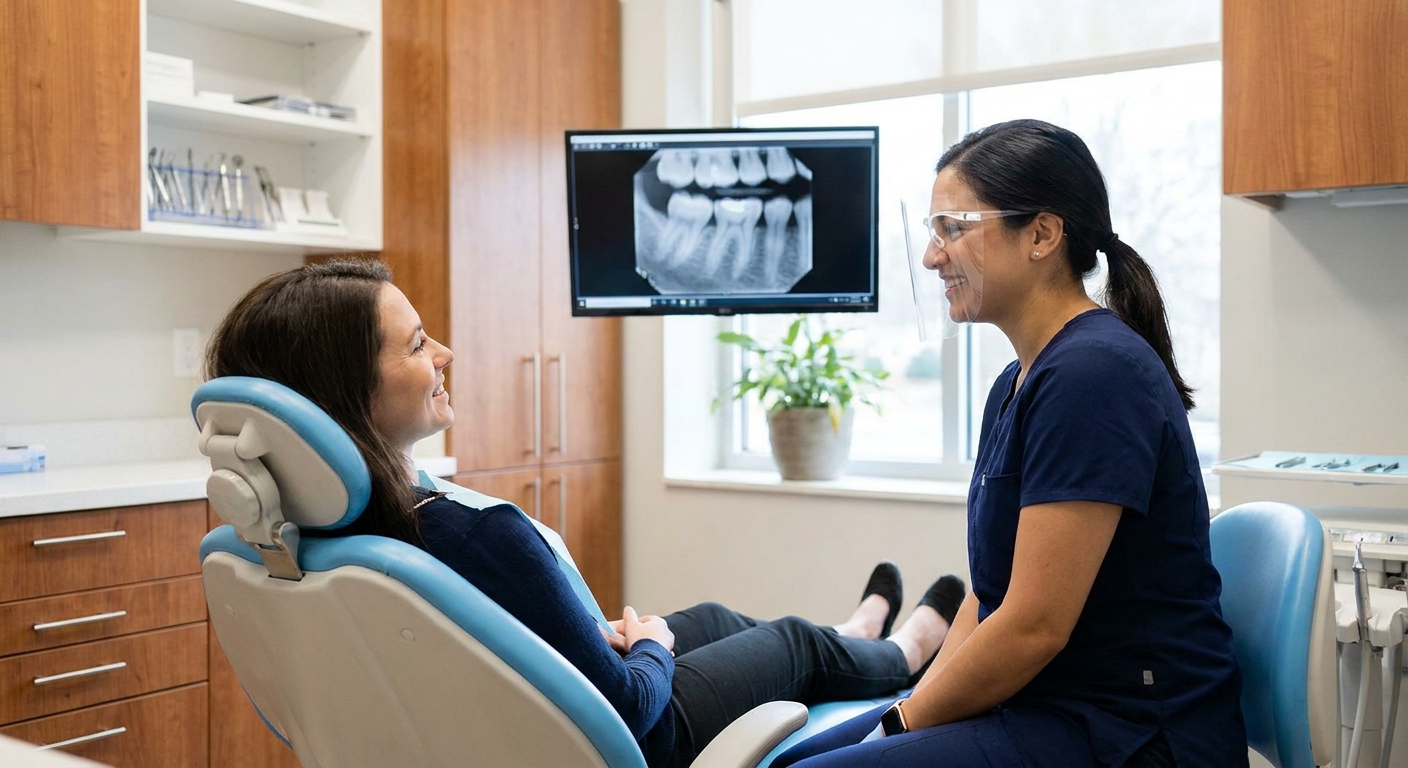
That estimate is built on what your exam actually shows. Digital X-rays and an intraoral camera let you see the tooth on a screen and understand why it needs attention. That matters if you have ever felt rushed or talked down to at a dental office. The team’s approach is compassionate care with no judgment about how long it has been since your last visit. The goal is personalized care that starts from where you are today.
Moores Chapel Dentistry serves patients across Charlotte, NC. The practice offers family dentistry under one roof, including exams, cleanings, gum disease care, restorative work, and emergency dental care, so a household with Cigna coverage can handle everyday care in one welcoming environment instead of juggling several offices. If a tooth starts hurting suddenly, emergency visits are part of that same care, so you are not searching for a stranger in a crisis.
If you want to see how insurance tends to treat other basic restorative work, this guide on how insurance treats dental bonding and similar procedures walks through the same kind of benefit questions.
Which Other Plans Does the Practice Accept, and What About Medicaid?
Moores Chapel Dentistry is in-network with Aetna, Cigna, and Delta Dental, accepts a range of other dental plans, and accepts Medicaid. Accepted plans that are not in-network may leave you with a different out-of-pocket cost, so ask for an estimate either way.
In-network:
- Aetna
- Cigna
- Delta Dental
Accepted, but not in-network:
- Ameritas
- Assurant
- Blue Cross Blue Shield
- Humana
- MetLife
- Mutual of Omaha
- Principal
- TeamCare
- TruAssure
- United Concordia
- UnitedHealthcare
- Unum
Also accepted:
- Medicaid
Why does the network difference matter? With an in-network plan, your cost is based on the insurer’s negotiated rate, and you are not billed above it. With an accepted plan that is not in-network, your plan may pay at its out-of-network level, so your share can be higher. That is not a reason to avoid care. It is simply a reason to get an estimate before your visit, the same as Cigna members do.
Medicaid deserves its own note. Adult dental coverage under Medicaid can differ from children’s benefits, and benefits can change over time. If you have NC Medicaid, bring your card and ask the team to check your current dental benefits for an extraction before scheduling. If anything is unclear, confirm directly with your Medicaid plan.
What If Cigna Denies or Underpays the Claim, and Can HSA or FSA Help?
A denied or lower-than-expected claim is not always the final answer. You can ask for the reason, have the office resubmit with records, and appeal to Cigna. HSA and FSA funds can also generally be used for dental care like extractions, which may help with any balance left over.
Claims can be denied for reasons that are sometimes fixable: a missing X-ray, a code question, a waiting period that just ended, or a coverage detail that needs more explanation. Work through it in this order:
- Request your explanation of benefits. This statement from Cigna shows what was billed, what was paid, and the reason for any denial or reduction. Read the reason code carefully.
- Ask the office to resubmit. If records were missing, the claim can be resent with the X-rays and clinical notes that show why the extraction was needed.
- File an appeal with Cigna. If resubmitting does not resolve it, follow the appeal steps in your plan documents or your Cigna member account. Keep copies of everything and note your appeal deadline.
Getting an estimate before treatment may reduce the chance of surprises at this step, because coverage questions can come up before the claim is filed, not after.
For the balance you owe, check your health savings account or flexible spending account. Under IRS Publication 502, dental care that prevents or treats disease, including extractions, is generally an eligible medical expense, while cosmetic-only work usually is not. Confirm the details with your account administrator. If your FSA has a use-it-or-lose-it deadline at year end, it may be a way to cover an extraction scheduled this fall. If cost is still a concern after insurance and account funds, bring it up when you review your estimate. An honest conversation about money is part of compassionate care, not an awkward extra.
So, does Cigna cover dental? For members with a Cigna dental plan, extractions are generally covered, and two numbers tell you much of what you may pay: your remaining annual maximum and the class your plan assigns to extractions. Find both in your Cigna dental plan summary today. Then call Moores Chapel Dentistry in Charlotte, NC with your Cigna member ID before you schedule, and ask the team to verify your benefits and walk you through what Cigna is expected to pay and what you may owe.
Questions About Your Cigna Coverage? Start with a Conversation
Figuring out what your plan pays toward a tooth extraction can feel like guesswork, and it’s easy to put off care while you wonder. Our team at Moores Chapel Dentistry in Charlotte, NC can talk through your situation and help you understand what to expect. If it’s been a while since your last routine exam and cleaning, that’s a good place to begin, so give the office a call.
Coverage, waiting periods, and pre-authorization rules vary by Cigna plan and employer group, and actual costs vary based on your exam and treatment needs. All dollar figures in the worked example are hypothetical and are not Cigna’s rates or Moores Chapel Dentistry’s fees. Always confirm your benefits directly with Cigna before treatment.