
You are standing at the front desk holding two insurance cards, one medical and one dental, and nobody can tell you which one pays for the tooth that has to come out. The question in your head is simple: can a tooth extraction be covered by medical insurance, or does it always fall on your dental plan? Dental insurance is the more common payer, and medical insurance may pay in some cases. What influences the answer is why the tooth is coming out and how that reason is written down. Think of your two cards as two doors into the same building. The care happens in the same room either way, but the claim has to go through the right door, and the diagnosis can help determine which door that is.
This guide walks you through how that decision works and what it may mean for your bill. It also explains how Moores Chapel Dentistry in Charlotte, NC, can help you review coverage questions before treatment instead of after.
Can a tooth extraction be covered by medical insurance, or is it always dental?
A tooth extraction is usually billed to dental insurance. Medical insurance may cover it when the extraction is tied to a medical problem, such as a spreading infection, an injury to the face or jaw, or a condition a physician is treating. Whether your medical plan pays depends on your plan, your diagnosis, and how the claim is coded.
Dental insurance is the default payer because most extractions are routine dental care. A tooth cracks, decay goes too deep, or gum disease loosens a tooth, and the dental plan handles it under its normal rules. Medical plans are built to cover illness and injury in the body as a whole. They tend to step in only when the tooth problem is part of a larger health issue, or when removing the tooth is a needed step in a medical treatment.
That split has a long history. A report on medically necessary dental services hosted by the NIH explains that Medicare has generally excluded routine dental care. It has, however, covered certain dental services tied to covered medical treatment, such as removing teeth to prepare the jaw before radiation therapy. Private medical plans often follow similar logic. The American Academy of Pediatric Dentistry keeps a reference of dental procedures most likely to be covered by medical plans, and the pattern is the same: medical coverage centers on care connected to a medical problem, not everyday dental work.
Here is what that can look like. If a tooth broke in a fall that also injured your jaw, your medical plan may be the first door. If a large cavity was left untreated, your dental plan is often the door. When both plans could apply, one is billed first as the primary plan, and the other may help with what is left. No office can promise how a medical plan will rule. What an office can do is help you ask questions before the claim is filed.
What makes an extraction medically necessary instead of cosmetic?
An extraction may be considered medically necessary when the tooth is causing or threatening harm, such as infection, a fracture, or decay too deep to repair. It may be considered cosmetic or elective when the tooth is removed mainly for looks or convenience. A clear record of the problem can make it easier for a payer to see which side of that line your tooth falls on.
Payers do not see your mouth. They see codes, notes, and images. A claim that just says “extraction” with no clear reason gives the reviewer very little to go on. A claim backed by notes describing swelling, an abscess, or a fracture below the gumline tells a fuller story. That is why documentation can matter alongside the procedure itself.
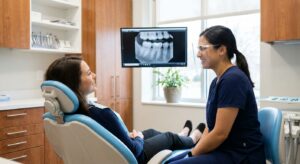
Moores Chapel Dentistry uses digital x-rays and an intraoral camera to record what the dentist sees. Digital x-rays show what is happening below the surface, such as infection at the root or bone loss around the tooth. The intraoral camera captures close-up images of cracks, broken edges, and decay that may be hard to see in a mirror. Together, these records document the reason for extraction in your chart. That reason is what your dental plan, and possibly your medical plan, will review.
If your tooth is painful, swollen, or infected right now, do not wait to sort out insurance first. Moores Chapel Dentistry offers emergency dental care for urgent needs, and coverage questions can be worked out alongside your care. If you have been putting this off because you worry it will hurt or that someone will judge you for waiting, that worry is common and understandable. The team’s focus is on keeping you comfortable while addressing your dental concern.
The type of extraction also shapes how plans classify it. In general terms:
- Simple extraction: the tooth is fully visible and can be removed without cutting gum or bone. Many dental plans place this in their basic services category.
- Surgical extraction: the tooth is broken at the gumline, or the gum must be opened or bone removed to reach it. Plans may place this in basic or major services, depending on the plan.
- Impacted tooth removal: the tooth is trapped under gum or bone, as wisdom teeth often are. This usually falls under oral surgery benefits and may require review before treatment.
- Extraction tied to trauma, serious infection, or medical treatment: a medical plan may be considered first, depending on the diagnosis and the plan.
- Removal for appearance or convenience only: often not covered by either plan.
Does dental insurance cover wisdom teeth removal? Dental insurance may help pay for wisdom teeth removal when the teeth are impacted, infected, or causing problems. Your share depends on your deductible, coinsurance, and annual maximum.
Wisdom teeth are a common place where both cards may come into play. Most plans treat removal as oral surgery, so the share they pay may differ from a simple extraction. Some plans also want x-rays and a pre-treatment review first. If the removal is linked to a medical issue, such as a cyst or an infection spreading beyond the tooth, a medical plan may share the cost, so it is worth checking both cards before you book.
How do deductibles, annual maximums, and pre-authorization change what you pay?
Your deductible comes out of your pocket before the plan pays. Your annual maximum caps what the plan will pay in a benefit year. Pre-authorization lets the plan review a more involved case before treatment. Together, these three influence whether your extraction bill is small, moderate, or close to the full fee.
What percentage does dental insurance cover for tooth extractions? Some dental plans pay about 70 to 80 percent of the allowed fee for a simple extraction after your deductible, and some pay around 50 percent when a surgical extraction falls under major services. Your exact percentage is the coinsurance your plan assigns to that category, and it is printed on your summary of benefits.
Look for the lines labeled basic services, major services, or oral surgery. Simple extractions often land in a category that pays a larger share than the one where some surgical extractions land, but coverage varies by plan and carrier. Dental plans are also built differently from medical plans. A systematic review of dental insurance describes the many ways dental coverage is organized and paid for. That variety is one reason two people with insurance can owe different amounts for the same procedure.
Here is how the main factors can play out, using a hypothetical $300 allowed fee, a $75 deductible, and a plan that pays 75 percent after the deductible. These numbers are for illustration only. They are not Moores Chapel Dentistry’s fees or your plan’s rates.
| Your situation | What you may pay | Hypothetical example |
|---|---|---|
| No dental insurance | The office’s full fee for the procedure | $300 |
| Dental plan, deductible not yet met | Your remaining deductible, then your coinsurance share of the rest | $75 + 25% of $225 = $131.25 |
| Dental plan, deductible already met | Your coinsurance share only | 25% of $300 = $75 |
| Dental plan, annual maximum already used | Often the full allowed fee until the benefit year resets | $300 |
| Accepted plan where the office is not in-network | Your coinsurance share, plus any difference between the office fee and what the plan allows | Varies by plan |
| Medical plan reviewed first for a qualifying diagnosis | Your medical deductible, copay, or coinsurance, with the dental plan possibly helping with the rest | Varies by plan |
The annual maximum catches some people by surprise. If you had a crown and fillings earlier in the year, your plan may have little left to spend. In that case, timing can matter. If your dentist says the extraction is not urgent, you could ask whether scheduling it after your benefit year resets makes sense. If it is urgent, do not delay care for the sake of insurance.
Pre-authorization, often called predetermination on dental plans, is a request for the plan to review a procedure before you have it. It is more common for surgical or impacted extractions. It is not a promise of payment, but it can give you a clearer picture of what the plan expects to pay.
Health savings accounts and flexible spending accounts may help with whatever insurance leaves behind. Extractions done to treat a dental problem are generally eligible HSA and FSA expenses, while purely cosmetic work usually is not. Your account administrator can confirm the current rules for your account. If insurance does not cover the full cost, the team at Moores Chapel Dentistry can talk through payment questions with you before treatment.
Which insurance plans does Moores Chapel Dentistry work with in Charlotte, NC?
Moores Chapel Dentistry is in-network with Aetna, Cigna, and Delta Dental. The practice also accepts several other dental plans and Medicaid, and the team checks your specific plan rather than guessing.
In-network plans:
- Aetna
- Cigna
- Delta Dental
Also accepted:
- Ameritas
- Assurant
- Blue Cross Blue Shield
- Humana
- MetLife
- Mutual of Omaha
- Principal
- TeamCare
- TruAssure
- United Concordia
- UnitedHealthcare
- Unum
- Medicaid
The difference between in-network and accepted matters for your costs. With an in-network plan, the office has agreed to the plan’s negotiated fees, which may keep your share lower. With an accepted plan, the office will work with your coverage, but your share may be higher, depending on how your plan handles care outside its network.
Charlotte patients may run into one more wrinkle. Several of these companies also sell medical insurance, so your medical card and your dental card may carry the same company name. They are still separate plans with separate rules. A dental network contract does not tell you how your medical plan will treat an extraction, and the reverse is also true.
If you have Medicaid, adult dental coverage is set by each state, so North Carolina’s own rules decide what applies to your extraction. Moores Chapel Dentistry accepts Medicaid and checks the current NC Medicaid rules for your specific case rather than assuming what is covered.
Moores Chapel Dentistry serves patients throughout Charlotte, NC, including nearby neighborhoods such as Arlington and Paw Creek. Because the practice offers comprehensive family dental services under one roof, the same team that checks your benefits can also care for the rest of your family, keeping coverage questions in one place.
What should you do before your appointment, and what if a claim is denied?
Before your appointment, bring both insurance cards, ask that the reason for extraction be recorded clearly, and request a pre-treatment estimate. If a claim is denied, ask for the reason in writing and talk with the office about an appeal or about billing your other plan.
These steps take a few minutes and may help you avoid unexpected costs:
- Bring both cards. Bring your medical card and your dental card, even if you think only one applies.
- Ask that the reason be written in your chart. If the tooth is coming out because of infection, a fracture, or an injury, those words should appear in your record.
- Ask for a pre-treatment estimate. It should show what your plan is expected to pay and what your share may be.
- Ask whether medical billing applies. If the extraction is tied to an injury or a condition your physician is treating, ask the team whether your medical plan should be checked first.
- Ask about payment options for any remaining balance. Talking about it upfront means you can plan for it, including with HSA or FSA dollars.
Even with preparation, a claim can come back denied. Denials happen for many reasons: a missing x-ray, a code that does not match the notes, a plan that thinks another plan should pay first, or a benefit limit you did not know about. Start by asking for the denial reason in writing. Then ask the office whether an appeal makes sense and whether the claim should go to your other plan instead. Some denials come down to paperwork rather than a lack of coverage.
Moores Chapel Dentistry focuses on compassionate care, and that includes helping you understand your benefits before treatment instead of leaving you to decode an explanation of benefits on your own. If you want to see how the practice approaches coverage questions for other procedures, this guide on how insurance handles dental bonding follows the same plain-language approach.
Quick answers Charlotte patients want about extraction coverage
Most extraction coverage questions come down to which plan pays, how much, and what to do when the answer is unclear. Here are short answers to ones that come up often.
Can a tooth extraction be covered by medical insurance?
Sometimes. Medical plans may pay when the extraction is tied to infection, trauma, or a condition a physician is treating, but it depends on your plan, your diagnosis, and how the claim is coded.
Does dental insurance usually pay for tooth extractions?
Dental plans are the usual payer. How much they pay depends on your deductible, your annual maximum, and the category your plan assigns to the extraction.
Can I use my HSA or FSA to pay for a tooth extraction?
Extractions done to treat a dental problem are generally eligible HSA and FSA expenses. Check with your account administrator for the current rules.
Does North Carolina Medicaid cover tooth extractions for adults?
Adult dental coverage is set by the state, so it depends on current North Carolina rules and your specific case. Moores Chapel Dentistry accepts Medicaid and checks coverage for your extraction before treatment.
Can I get a cost estimate before the extraction?
You can ask the office for a pre-treatment estimate showing what your plan is expected to pay and what your share may be.
What should I do if my extraction claim is denied?
Request the denial reason in writing, ask the office about an appeal, and check whether your other plan should be billed.
Your next step is simple. Bring both your medical and dental insurance cards to Moores Chapel Dentistry in Charlotte, NC, and ask the team to check your benefits and prepare a pre-treatment estimate before your extraction is scheduled. If your tooth is coming out because of an infection or an injury, ask that the diagnosis be written in your chart in those terms. That detail is something a medical plan may look for, and it costs you nothing to request.
Have Questions About Your Extraction Coverage?
Figuring out whether your dental or medical plan applies to a tooth extraction can feel confusing, and it is easy to put off care while you sort it out. The team at Moores Chapel Dentistry in Charlotte, NC can talk through your situation and help you understand what to ask your insurer before you decide anything. Give the office a call to get started.
Insurance coverage, costs, and claim outcomes vary by plan, carrier, and diagnosis. The percentages and examples on this page are general and for illustration only. They are not a quote or a guarantee of payment.