
The answer is on your Delta Dental benefits summary, under the category your plan assigns to endodontics. Most Delta Dental plans that include basic or major restorative benefits help pay for a root canal, usually at a percentage of the allowed fee after your deductible and any waiting period. Some lower-tier plans exclude major services, and then the full cost is yours. Which plan you have, whether your dentist, such as Moores Chapel Dentistry, is in network, how much of your annual maximum is left, and which tooth is involved together decide what you pay.
This guide covers how those pieces fit together, how to estimate your share before treatment, and what to do if a claim is denied. It is written for working adults, parents dealing with a child’s dental injury, and older patients managing ongoing tooth pain.
Understanding coverage basics
What is a root canal treatment
A root canal is an endodontic procedure that removes infected or inflamed pulp from inside a tooth. After the root canal system is cleaned and disinfected, the space is filled with a biocompatible material. The tooth then typically gets a permanent filling or a crown to restore function and protect it. This treatment relieves pain and can save a damaged tooth that might otherwise need to be extracted.
Many people delay treatment because they worry the procedure itself will be painful. Harvard Health has a plain-language overview of what to expect during a root canal, covering the appointment from numbing through restoration. Patients who have read concerns online about root canals and overall health can look at the American Association of Endodontists’ fact sheet on root canal safety, which addresses those claims directly.
Why coverage matters
A root canal is usually only one part of the bill. The full course of care often includes diagnostic X-rays, the endodontic treatment itself, and then a filling or crown. Each item may fall into a different benefit category. A plan can pay for the X-rays at one rate, the root canal at another, and the crown at a third. If you know where each item falls before you sit in the chair, you can avoid surprises at checkout and get treatment sooner, before an infection spreads or a tooth cracks further.
Delta Dental plan details
Plan types overview
Delta Dental is not a single plan. It is a family of companies offering many products through employers, individual marketplaces, and government programs. The two names patients see most often are Delta Dental PPO and Delta Dental PPO Premium or similarly tiered individual plans. Employer plans are built to the employer’s specifications, so two coworkers with “Delta Dental” cards can have very different root canal benefits if they chose different tiers.
Check these items in your plan documents:
- Service category for endodontics. Some plans list root canals as a basic service. Others group them with major services such as crowns, bridges, and dentures.
- Coverage percentage for that category.
- Waiting period before that category becomes active on a new plan.
- Deductible, and whether it applies to that category.
- Annual maximum, and how much of it you have used this year.
Basic tier vs premium tier plans
On many entry-level individual plans, major services are excluded or covered only after a long waiting period. If endodontics is classified as major on such a plan, you could be responsible for the full cost of a root canal.
Higher-tier plans usually cover major services at a set percentage after the deductible. Waiting periods for major services vary by state, by plan, and sometimes by tier within the same product. Employer-sponsored plans often shorten or waive waiting periods, while individual plans bought on your own are more likely to have them. Your benefit booklet or member portal will list the wait that applies to you.
Coverage percentages by service type
Dental plans commonly use a three-level structure, sometimes called 100-80-50 in plan descriptions:
- Preventive services such as cleanings, exams, and routine X-rays are often covered at the highest rate, frequently with no waiting period.
- Basic services such as fillings and simple extractions are typically covered at a middle rate.
- Major services such as crowns, and root canals on plans that classify them as major, are typically covered at a lower rate once the waiting period and deductible are satisfied.
These are typical patterns, not guarantees. Your own percentages are printed in your summary of benefits.
Factors affecting your coverage
Affected tooth and complexity
Root canal fees usually depend on which tooth needs treatment. Front teeth generally have a single canal. Premolars may have one or two. Molars have multiple roots and canals that take more time and skill to clean and seal. Because each type of tooth is billed under its own procedure code, a molar root canal usually costs more than a front tooth root canal. Your coinsurance is a percentage, so your share rises with the fee.
Retreatment of a tooth that already had a root canal, or a case that needs a specialist, can change the fee and the code again. Ask what code your dentist plans to submit so you can look up the matching benefit.
The restoration after the root canal
A back tooth that has had a root canal is often restored with a crown, since the remaining structure can be brittle. Crowns are almost always a major service. Many plans also have frequency limits on crowns and may ask for X-rays showing the crown is needed. Budget for this step along with the root canal, and ask for both to be included in any pretreatment estimate.
In-network vs out-of-network
You generally save the most with a dentist who participates in your Delta Dental network. In-network providers agree to a fee schedule negotiated by Delta Dental, so your share is calculated from that discounted fee and the dentist cannot bill you the difference between their regular fee and the contracted rate.
With an out-of-network dentist, Delta Dental may base its payment on a maximum allowed amount that is lower than the dentist’s actual charge. You can be responsible for the gap in addition to your coinsurance. Some plans, such as DHMO-style products, pay little or nothing outside the network.
Moores Chapel Dentistry in Charlotte is an in-network provider for Delta Dental, along with Aetna and Cigna. That means a Delta Dental PPO patient’s portion is figured from the contracted fee.
Deductibles and annual maximums
Most plans require you to meet an annual deductible before major service coverage starts, with separate individual and family amounts. After the deductible, you still pay your coinsurance on the allowed fee.
The annual maximum is the most the plan pays in a benefit year. Root canals and crowns use up a maximum quickly. If you have already had other work done this year, your remaining maximum may be smaller than the cost of a root canal and crown together. Once the limit is reached, further services are your responsibility until the plan year resets.
Estimating your out-of-pocket
Sample cost breakdown
The numbers below are hypothetical and show only how the math works. Your dentist’s contracted fee, your deductible, and your coverage percentage will be different.
Say a molar root canal has an allowed fee of $1,200. Your plan has a $50 deductible you have not met yet and pays 50 percent for major services.
| Description | Amount |
|---|---|
| Allowed fee | $1,200 |
| Deductible (you pay) | $50 |
| Remaining balance | $1,150 |
| Delta Dental pays (50% of $1,150) | $575 |
| Your coinsurance (50% of $1,150) | $575 |
| Your total share | $625 |
Your total share is the deductible plus your coinsurance. If the same plan classified root canals as a basic service with a higher coverage rate, your share would drop. If your remaining annual maximum were below $575, you would also owe the difference.
Calculating your share
- Ask the office for the allowed fee and procedure code for the planned treatment.
- Subtract any part of your annual deductible you have not met.
- Apply your plan’s coverage percentage for that service category to the remaining amount.
- Compare what the plan would pay with your remaining annual maximum.
- Repeat for the crown or final restoration, if one is planned.
How to maximize benefits
Pretreatment estimates
Before a planned root canal, you can ask your dentist to submit a pretreatment estimate, sometimes called a predetermination, to Delta Dental. The plan sends back a written breakdown of what it expects to pay and what you will owe, based on your eligibility and benefits when it is reviewed. It is an estimate, not a guarantee, because benefits are rechecked when the claim is filed. Processing takes time, so for a painful or infected tooth, your dentist may advise treating first instead of waiting for the reply.
Choosing the right provider
Delta Dental’s “Find a Dentist” tool on its website lets you search by location, network, and specialty. Before booking, confirm with the office that it participates in the specific network listed on your card, since Delta Dental runs more than one.
Some root canals are done by a general dentist and others are referred to an endodontist. If you are referred, check that the specialist is also in your network.
Timing and scheduling
If you have already met your deductible and still have room under your annual maximum, completing treatment within the current benefit year can stretch your coverage. When a root canal and crown are both needed late in the year, some patients have the root canal now and the crown after the plan resets, which divides the cost between two annual maximums. Talk this through with your dentist first, because waiting too long to place a crown can leave a treated tooth exposed to fracture.
Finding an in-network provider in Charlotte
Benefits of in-network care
Choosing a provider in the Delta Dental network:
- Limits your cost to the contracted fee
- Usually means the office files the claim and you pay only your estimated share at the visit
- Makes your benefits easier to predict before treatment
Starting with an exam
Not every toothache means you need a root canal. Pain can come from a cracked filling, gum problems, a sinus issue, or a tooth that needs a simpler repair. An exam with X-rays is how a dentist tells these apart, and these diagnostic services usually fall under your plan’s preventive or diagnostic benefits.
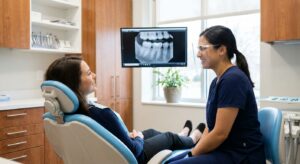
Moores Chapel Dentistry is a family practice serving Charlotte, Arlington, Belmont, and Paw Creek. It offers emergency dental care, restorative dentistry, digital X-rays, and an intraoral camera that lets patients see the tooth on a screen during the exam. The practice at Moores Chapel Dentistry aims to handle routine and more complex needs in one place without sending families to multiple offices, and it will tell you if a specialist referral is the right choice for your tooth.
Booking an urgent appointment
For severe tooth pain, swelling, or a tooth injured in an accident, ask for the earliest emergency slot. When you call, mention your Delta Dental coverage and describe your symptoms. Many offices keep openings for urgent cases and can confirm eligibility while you are on the way.
Common questions answered
Is an emergency root canal covered
Usually yes, if your plan includes benefits for endodontics and you have met any waiting period. Emergency treatment is generally covered at the same percentage as planned treatment. Some plans also cover a separate palliative or emergency exam visit to relieve pain before the full root canal is done.
What if my plan does not cover root canals
If your plan excludes major services or you are still inside a waiting period, you still have options:
- Pay out of pocket and ask the office about payment arrangements
- Check whether a secondary dental plan, such as one through a spouse’s employer, adds coverage
- Ask your dentist which alternatives exist for your tooth, such as extraction, and what each one means long term
Extraction is often cheaper up front, but replacing a missing tooth later can cost more than saving it. Ask for a side-by-side comparison before deciding.
How to appeal a coverage decision
If Delta Dental denies or reduces a claim, start with the explanation of benefits (EOB), which lists the reason. Common causes include an unmet waiting period, a reached annual maximum, a frequency limit, or missing documentation. You can:
- Ask your dentist’s office to review how the claim was coded and submitted
- Send additional information, such as X-rays or clinical notes
- File a formal appeal using the instructions in your member portal or benefit booklet, within the deadline listed there
Next steps and resources
What to do if you have pain
If a sudden, severe toothache starts, try rinsing with warm salt water, chewing on the other side, and taking an over-the-counter pain reliever as the label directs. Then arrange an urgent dental visit. Facial swelling, fever, or trouble swallowing call for prompt care, since these can be signs of a spreading infection. For general background on tooth decay and oral health, the National Institute of Dental and Craniofacial Research and the American Dental Association’s consumer site, MouthHealthy, are reliable starting points.
Contacting Delta Dental
For details specific to your plan, log in to your Delta Dental member portal or call the customer service number on your ID card. Ask four questions: how endodontics is classified on your plan, what percentage it is covered at, whether a waiting period applies, and how much of your annual maximum is left.
Knowing these answers before treatment lets you focus on getting the tooth taken care of. With your plan category, your network status, and a clear estimate in hand, you can decide on a root canal with Delta Dental knowing what to expect at checkout.