
Medicaid coverage for single tooth replacement depends on the state program you are enrolled in and on whether you are a child or an adult. For children, dental care is a required Medicaid benefit, so replacing a missing tooth is evaluated under the children’s benefit. For adults, dental coverage is optional for each state, and many programs that do cover adult dental care limit what they pay for to exams, extractions, fillings and removable appliances. A dental implant for one missing tooth is often excluded for adults or approved only with strong documentation of medical necessity and prior authorization. If you live in Charlotte near Moores Chapel Dentistry, the rules that apply to you are the ones in your North Carolina Medicaid plan materials, so the most reliable step is to confirm your adult dental benefits before planning treatment.
This guide explains how Medicaid dental benefits are structured, what “medical necessity” usually means, which replacement options a program may consider, how crowns and same-day restorations fit in, and how to make the most of the benefits you have. Moores Chapel Dentistry in Charlotte accepts Medicaid, and the sections below reflect the kinds of questions patients bring to a general and family practice when a tooth is lost or needs to come out.
Medicaid dental coverage
State eligibility and expansion
Medicaid is a joint federal and state program, and each state designs its own dental benefit within federal rules. The most important rule for tooth replacement is the split between children and adults. According to MACPAC’s review of Medicaid coverage of adult dental services, states are not required to cover dental services for adults, and the scope of adult coverage ranges from none, to emergency-only care, to limited benefits, to more extensive benefits. That range is why two people with Medicaid in different states can get very different answers to the same question about replacing a single tooth.
States also differ in how they deliver dental benefits. Some pay dentists directly through a fee-for-service arrangement, while others contract with managed care organizations or dental plans that administer benefits for the state. Research on dental coverage through Medicaid managed care compared with fee-for-service looks at how these delivery models can affect the care beneficiaries use. For you, the practical point is that your member handbook, your plan’s website and your plan’s member services line are where the specific rules for your coverage are spelled out.
Adult benefits versus child benefits
Children enrolled in Medicaid are covered under the Early and Periodic Screening, Diagnostic and Treatment benefit, often called EPSDT. The 2023 Medicaid and CHIP Oral Health at a Glance report describes dental services as part of the benefit package for children in Medicaid and CHIP. Under EPSDT, services needed to correct or improve a child’s condition are generally evaluated on medical need, which can include restorative work and, in some cases, space maintainers or other appliances when a tooth is lost early.
Adults face a narrower path. Where adult dental benefits are limited, a program may pay to remove a damaged tooth but not to replace it with a fixed restoration. Where benefits are broader, a program may cover a removable partial denture to fill a gap, and in fewer cases a bridge or an implant when strict criteria are met. If you are an adult, it is worth reading your benefit summary for the words “prosthodontics,” “removable prosthetics,” “fixed prosthetics” and “implant services,” since those categories usually decide whether single tooth replacement is covered.
Implant coverage rules
When a Medicaid program covers dental implants at all, they typically fall under prosthetic or restorative services and come with conditions. Common requirements include proof of medical necessity, a written treatment plan, supporting x-rays and prior authorization before any work begins. Many programs exclude implants for adults entirely and point instead toward a removable option. Even in programs that list implants as possible, approval is usually case by case rather than automatic.
It also helps to know that Medicare is a separate program. The CMS page on Medicare dental coverage explains that Original Medicare generally does not pay for most dental care, such as routine cleanings, fillings, extractions or dentures, outside of specific medically related situations. People who have both Medicare and Medicaid should look to Medicaid, or to any Medicare Advantage plan with dental extras, for routine and restorative dental benefits.
Medical necessity criteria
Qualifying conditions
Medicaid programs generally describe medical necessity for tooth replacement as a condition that significantly affects oral health or daily function, not appearance alone. Factors that programs commonly weigh include:
- Tooth loss that affects chewing, nutrition or speech
- Shifting or damage to neighboring teeth caused by a gap
- Bone loss or jaw problems that require structural support
- Congenitally missing teeth or tooth loss from a traumatic injury
Meeting one or more of these factors can strengthen a request, but it does not guarantee approval. Each program sets its own definition, and some apply medical necessity only within the services they already list as covered. A missing front tooth, for example, may matter a great deal to you socially and professionally, yet a program may treat replacing it as cosmetic unless function is affected.
Documentation requirements
When prior authorization is required, a complete request usually includes:
- A detailed treatment plan from a licensed dentist
- Current x-rays showing the area, the neighboring teeth and the supporting bone
- A written explanation of the functional problem the replacement would solve
- The prior authorization forms your plan requires
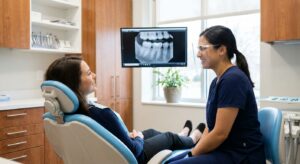
A complete package helps the review move without repeated requests for more information. At a practice that uses digital x-rays and an intraoral camera, as Moores Chapel Dentistry does, images of the affected area can be captured during the exam and included with the paperwork, which gives reviewers a clear picture of the tooth and the surrounding gum and bone.
Single tooth replacement coverage
Covered procedures
A single tooth replacement is rarely one procedure. Depending on the option, it can involve several separate services, each reviewed on its own:
- Extraction, if the damaged tooth is still present
- Removable partial denture, a removable appliance that fills one or more gaps
- Fixed bridge, which uses crowns on the teeth on either side of the gap to hold a replacement tooth
- Implant placement, followed by an abutment and an implant crown
Coverage can differ for each step. In some programs the extraction is covered while the replacement is not. In others a removable partial denture is covered while a bridge or implant is excluded for adults. Where implant services are allowed, a program may approve one component and not another, so it is important to see the authorization for every part of the plan before treatment starts.
What drives your cost
Because Medicaid benefits, fee schedules and exclusions vary by state and by plan, there is no single price that applies to everyone. Your share for a single tooth replacement under Medicaid generally comes down to a few things:
- Whether the specific replacement option is a covered service for your age group
- Whether prior authorization was requested and approved before treatment
- Any copayment your program sets for dental services
- Charges for parts of the treatment that the program does not cover, such as an upgraded crown material or an elective procedure
- Charges for sedation or additional imaging that the program does not consider necessary
If part of a treatment plan is not covered, ask for a written estimate that separates covered and noncovered services so you know what you would be responsible for before you agree to anything.
Same-day crown coverage
Coverage for same-day solutions
Same-day crowns are designed and milled in the office, which can reduce the number of visits. For Medicaid, the method used to make a crown is usually less important than whether crowns are a covered service for you at all. Many adult Medicaid dental programs limit or exclude crowns, especially on back teeth, and favor fillings or extraction instead. Where crowns are covered, programs tend to set rules about which teeth, which materials and how often a crown may be replaced. If you are considering a crown as part of a bridge or on an implant, confirm that the crown itself is authorized, not only the tooth preparation or the implant.
If you also carry private dental insurance, that plan may pay for a crown that Medicaid does not. Private plans set their own rules, so ask the private carrier how it classifies the crown and what you would owe.
Network providers
Finding a dentist who participates with Medicaid is often the first real hurdle. The ADA Health Policy Institute’s report on barriers to dental care among adult Medicaid beneficiaries discusses factors that affect whether adults with Medicaid use dental care, including the availability of participating dentists. Your plan’s provider directory is the best starting place, followed by a call to confirm the office is currently accepting your plan.
Moores Chapel Dentistry accepts Medicaid and serves patients from Charlotte, Arlington, Belmont and Paw Creek. For patients with private coverage, the practice is in network with Aetna, Cigna and Delta Dental. It also works with other carriers, including Blue Cross Blue Shield, MetLife and UnitedHealthcare, on an out-of-network basis, which means members of those plans use their plan’s out-of-network benefits and should check how their plan pays outside its network.
Maximizing your benefits
Finding the right dentist for your plan
Start with your Medicaid plan’s directory or member handbook to find participating dental offices. When you call, ask whether the office accepts your specific plan, which replacement options it provides and whether it handles prior authorization requests. Not every general practice offers every replacement option, and some cases require a referral to a specialist. A general dentist can still be the right first stop, because the exam, x-rays, extraction if needed and treatment planning usually begin there, and the dentist can tell you whether a referral makes sense.
Moores Chapel Dentistry provides general, family, restorative and emergency dental care, including exams, digital x-rays, fillings, bonding and treatment for gum disease. Healthy gums and stable neighboring teeth matter for any replacement option, so treating decay or gum disease first is often part of the plan.
Combining with other insurance
If you have more than one form of coverage, such as a private dental plan or a Medicare Advantage plan with dental benefits, the plans coordinate benefits under set rules. In most cases Medicaid pays last, after any other coverage has paid its share. Bring information for every plan you have to your visit so the office can bill them in the correct order. Coordinating coverage this way can reduce your out-of-pocket share for services that more than one plan covers.
Exploring financial assistance
If gaps remain after coverage, options to look into include:
- Dental school clinics, which often offer reduced fees
- Local health departments and community health centers with dental programs
- Nonprofit programs that help with dental costs
- Payment arrangements or financing, if an office offers them
Asking about these options early can help you choose a replacement plan you can complete rather than one that stalls partway through.
Frequently asked questions
What if my plan doesn’t cover implants?
If implants are excluded, ask your dentist which alternatives your plan does cover. A removable partial denture is the option most often covered for adults, and some plans cover a fixed bridge. You can also consider paying for an implant privately or using private insurance if you have it. Leaving a gap untreated can allow neighboring teeth to drift, so it is worth discussing a short-term and long-term plan.
How long does prior authorization take?
Timelines vary by state and by plan. Your plan’s member handbook or member services line can tell you the expected review time. Submitting complete records and forms at the start reduces back-and-forth and keeps the request moving.
Can I get an implant and crown on the same day?
Medicaid programs rarely approve same-day implant protocols. When implants are covered, placement and the final crown are usually separate steps, with healing time in between. Ask how your plan handles each stage before treatment begins.
Will Medicaid cover sedation for tooth replacement?
Sedation coverage is limited in many programs. Some approve it when there is a documented medical need, while others treat it as an elective add-on. Confirm sedation coverage with your plan in advance if you expect to need it.
What should I bring to my appointment?
Bring your Medicaid card, any secondary insurance information, referral letters, recent x-rays from another office and a list of your medications. Having these ready helps the office verify coverage and plan treatment efficiently.
Understanding how your Medicaid program treats adult dental care, what counts as medical necessity and which replacement options are covered puts you in a stronger position to plan for a missing tooth. Confirm your benefits, ask for written estimates that separate covered and noncovered services, and secure any required approvals before treatment so the restoration you choose fits both your health needs and your budget.