
A Cigna in network denture provider is a dentist who has a current contract with your specific Cigna dental plan. When you use one, your denture work is billed at Cigna’s negotiated rates, and the office submits the claim for you. Moores Chapel Dentistry in Charlotte is in network with Cigna. Before any denture work begins, though, you still need to confirm three things: which Cigna plan type you have, how that plan treats dentures, and what the office will actually do for your case. This guide walks through each step so you can compare options in Charlotte, Arlington, Belmont, or Paw Creek with fewer surprises.
Understand denture coverage
Review your Cigna plan type first
Cigna sells several kinds of dental plans, and denture coverage works differently in each. The most common are the Dental PPO (DPPO) and the Dental HMO (DHMO). Some employers also offer exclusive provider or point of service designs. The plan type decides who counts as “in network,” how you pay, and whether you need to choose a primary dentist.
- DPPO plans usually let you see any dentist. Network dentists accept Cigna’s negotiated fees, so your share is typically lower in network than out of network.
- DHMO plans usually require you to pick a network general dentist and get care there. They often list a fixed patient charge for each covered procedure rather than a percentage. You can see how this works in a published Cigna DHMO summary, such as the Cigna DHMO plan document prepared for City of Richmond employees. That document is for a different employer’s plan, so use it only to understand the format, not your own costs.
Your own plan documents control what you pay. Log in to your Cigna account or look at the benefit summary from your employer before you assume anything.
Know which denture types your plan recognizes
Dentures are not one service. Plans usually list each type under its own procedure code, and coverage can differ between them. Common options include:
- Complete (full) dentures that replace all the teeth in an upper or lower arch
- Partial dentures that replace a few missing teeth and attach to the teeth you still have
- Implant-supported dentures that are anchored to dental implants
Many plans treat full and partial dentures as major services. Implant-supported dentures are often handled in pieces: the denture itself may be covered while the implants are limited or excluded. Ask Cigna, or the dental office, to check each part of your proposed treatment separately.
Check deductibles, maximums, waiting periods, and frequency limits
These four plan rules shape your out-of-pocket cost more than anything else:
- Deductible. Many DPPO plans require you to pay a set amount before major services are covered. DHMO plans often have no deductible.
- Annual maximum. DPPO plans typically cap what they pay in a benefit year. Denture cases can use up much of that cap, so timing matters if you also need extractions or other work.
- Waiting period. Some plans require you to be enrolled for a period before major services like dentures are covered.
- Replacement limit. Plans often limit how frequently they will pay for a new denture. If you already have a denture, ask when the plan will cover a replacement.
Write these down for your plan. They are the numbers you will need when you compare estimates.
Find in-network providers
Use Cigna’s provider directory
Search Cigna’s online directory or mobile app and filter by your plan. A dentist can be in network for one Cigna product and not another, so the plan filter matters. General dentists who provide restorative care often handle dentures. Prosthodontists, who focus on replacing teeth, may take on more complex cases.
Confirm network participation directly
Directories are not always current. Once you have a shortlist, contact each office and ask:
- “Are you in network for my specific Cigna plan?”
- “Do you provide denture care here, or do you refer it out?”
- “Will you send a pre-treatment estimate to Cigna before we start?”
A pre-treatment estimate is one of the most useful tools you have. The office submits the planned procedure codes, and Cigna responds with what it expects to pay. It is not a guarantee, but it narrows the gap between what you expect and what you are billed.
If network status is unclear
If an office and the directory disagree, call the member services number on the back of your Cigna card. Member services can confirm whether a dentist participates in your plan on the date you plan to be seen. Record the date and the name of the representative you spoke with.
Evaluate provider experience
General dentist or specialist
Many people get dentures from their general or family dentist, especially for straightforward full or partial cases. A prosthodontist may be a better fit if you have significant bone loss, a complex bite, or a history of dentures that never fit well. If your general dentist refers you out, ask whether the specialist is also in network for your Cigna plan, because network status is checked for each provider.
Questions to ask about clinical experience
When you talk with an office, ask:
- How often do you make and fit dentures?
- Can you show photos of similar cases?
- How do you take impressions or scans, and how many visits does a typical case take?
- Who handles adjustments after the denture is delivered?
Look at the tools and the process
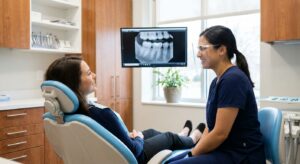
Good denture care depends on accurate records of your mouth. Digital X-rays help the dentist assess the bone and remaining teeth, and an intraoral camera lets you see what the dentist sees. Moores Chapel Dentistry uses both digital X-rays and an intraoral camera in its exams. Ask any office you consider how it gathers records, where the denture is fabricated, and how long repairs or relines usually take.
Compare out-of-pocket costs
Build your own estimate
Even with an in-network provider, you will usually share the cost. To estimate your part:
- Get the office’s fee for each procedure code in your treatment plan.
- Check your plan’s coverage level or fixed patient charge for each code.
- Subtract any deductible you have not met yet.
- Compare the plan’s payment to your remaining annual maximum.
- Ask about anything the plan may not cover, such as upgraded materials or extra lab work.
A written pre-treatment estimate from Cigna is the cleanest way to check your math.
Consider the whole treatment, not just the denture
Dentures rarely happen in a single step. You may need extractions, treatment for gum disease, or healing time before the final denture. Each of these is usually billed separately and may fall under different coverage levels. If your plan has an annual maximum, ask whether spreading treatment across two benefit years is clinically reasonable for you.
Discount plans versus insurance
Cigna and other companies sell dental discount plans, which are not insurance. They offer reduced fees at participating offices rather than paying claims. If you are considering one alongside or instead of insurance, confirm that the dentist you want participates and compare the actual fees for your treatment, not general savings claims.
Review treatment options
Removable versus implant-supported
Discuss with your dentist which type suits your mouth, health, and budget:
- Removable full or partial dentures are less invasive and usually less costly up front.
- Implant-supported dentures are more stable and help preserve bone where implants are placed, but they involve surgery, more time, and often more out-of-pocket cost because implant coverage varies widely.
There is no single right answer. The best choice depends on your bone, gum health, other medical conditions, and how much stability matters to you.
Materials and fit
Denture bases and teeth come in different materials, from standard acrylic to flexible resins for some partials. Upgraded materials can cost more, and your plan may pay only up to the level of a standard denture. Ask what is included in the quoted fee and what counts as an upgrade.
Check the patient experience
Reviews and word of mouth
Look for feedback on comfort, fit, how well the office explained costs, and how adjustments were handled. Pay attention to comments from patients whose situation sounds like yours.
Ask about follow-up care
Dentures need ongoing care. Your gums and jaw change over time, so fit changes too. Before you commit, confirm:
- How many adjustment visits are included after delivery
- What happens if a denture breaks or a tooth comes loose
- How the office handles urgent problems
Moores Chapel Dentistry provides emergency dental care as well as routine exams, which can matter when a denture breaks or a sore spot develops. If you still have natural teeth supporting a partial, regular cleanings and gum disease treatment help protect them. The practice treats gum disease as part of its general and restorative care.
Prepare for your consultation
Questions to bring
- What is included in the quoted price, and what is billed separately?
- How many visits will treatment take from start to finish?
- How are adjustments and relines handled, and are they included?
- Are partials or implant-supported options reasonable for me?
- Will you submit a pre-treatment estimate to Cigna?
Records to gather
- Recent dental X-rays, if you had them taken elsewhere
- A summary of past gum treatment or extractions
- Your Cigna member ID and benefit summary
- A list of current medications and medical conditions
Bringing these can shorten the first visit and help the office give you a more accurate estimate.
Make an informed decision
Weigh your options
Compare each office on:
- Confirmed network status for your exact Cigna plan
- Experience with cases like yours
- Clarity of the written estimate
- Follow-up and repair policies
- Location and how easy it is to return for adjustments
For many families in west Charlotte, having routine, restorative, and emergency care in one place means fewer separate offices to coordinate. Moores Chapel Dentistry describes its approach as personalized, compassionate care for every member of the family, with routine and more complex needs handled under one roof when possible.
Plan your next steps
Once you choose a provider:
- Get the pre-treatment estimate back from Cigna.
- Confirm the treatment sequence and timeline.
- Schedule any preparatory care, such as extractions or gum treatment.
- Ask about payment timing for your share.
Choosing a Cigna in network denture provider in Charlotte comes down to verifying your plan, confirming the office’s network status and experience, and getting costs in writing before treatment starts. Those steps protect your benefits and help you get a denture that fits and lasts.
Meta description: Looking for a Cigna in network denture provider in Charlotte, NC? Learn how Cigna DPPO and DHMO plans handle dentures, what to verify, and how to compare costs and care.