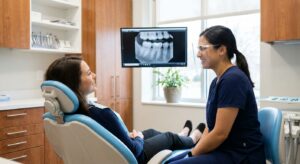

Blue Cross Blue Shield dental plans often pay something toward snap-in dentures, but rarely all of it, and the answer depends on your specific policy. Most BCBS dental plans place dentures and implant-related work in a higher-cost benefit tier, apply a deductible and an annual maximum, and may limit or exclude the implant posts themselves. Some plans pay for the denture portion but not the implants, and others cover both up to the yearly cap. In Charlotte, the clearest way to know is to read your plan’s benefit summary, ask BCBS how it handles implants and implant-retained dentures, and request a pre-treatment estimate before any work begins. Moores Chapel Dentistry accepts Blue Cross Blue Shield but is not an in-network provider for it, so BCBS members who visit the practice use their plan’s out-of-network benefits.
This guide explains what snap-in dentures are, how BCBS dental coverage tends to treat them, what drives your cost, and how to look after the finished denture.
Understanding snap-in dentures
What are snap-in dentures?
Snap-in dentures, also called implant-retained or implant-supported overdentures, are removable dentures that clip onto dental implants placed in the jawbone. A conventional denture rests on the gums and depends on suction, fit, and sometimes adhesive to stay put. A snap-in denture has attachments built into its base that lock onto matching connectors on the implants. You can still take it out to clean it, but it is held in place far more firmly while you eat and talk.
People usually consider them when they are missing all or most of the teeth in an arch, when a regular denture keeps slipping, or when they want a removable option that feels more secure.
How snap-in dentures work
The process generally happens in stages, and the timeline varies from person to person:
- Evaluation and imaging. The dentist reviews your health history, examines your mouth and gums, and takes imaging to see how much bone is available.
- Implant placement. A small number of implants are placed in the jaw, commonly two or more per arch, depending on the jaw and the design chosen.
- Healing. The bone needs time to bond with the implants before they carry a denture. This healing phase often lasts a few months.
- Attachments and impressions. Connectors are fitted to the implants, and impressions are taken so the final denture can be made.
- Delivery and adjustment. The denture is fitted, snapped into place, and adjusted over follow-up visits until it is comfortable.
Because the treatment spans several months and several procedures, it often touches more than one benefit category on a dental plan. That matters for insurance, as the sections below explain.
Key benefits of snap-in dentures
- Stability. The attachments help keep the denture from shifting while you chew or speak.
- Less reliance on adhesive. Many wearers find they no longer need denture paste.
- Removable for cleaning. Unlike a fixed bridge, you can take the denture out to clean it and the implants beneath.
- Support for the jaw. Implants place load on the bone in a way a gum-supported denture does not, which is one reason dentists recommend them for some patients.
They are not right for everyone. Bone quality, gum health, medical conditions, and budget all play a part, and an evaluation is the only way to know whether you are a candidate.
BCBS coverage basics
Plan types and what to look for
Blue Cross Blue Shield is a group of independent companies, and dental coverage under the BCBS name varies widely. You may have a plan through an employer, an individual plan, or a federal employee dental program, and each one sets its own rules. Two people with “BCBS dental” can have very different benefits for the same snap-in denture.
When you open your Summary of Benefits, look for these items:
- Which category dentures fall into (often called major or prosthodontic services)
- Whether implants are listed as covered, limited, or excluded
- Your deductible and annual maximum
- Any waiting period before major services are covered
- Replacement limits, such as how often a new denture will be paid for
- How out-of-network claims are paid, including whether the plan uses a set allowed amount
How the parts of treatment may be covered
The denture itself. Many dental plans treat complete dentures as a major service. An implant-retained denture may be paid as a denture, or the plan may pay only what it would for a conventional denture and leave the difference to you. This is sometimes called an alternate benefit.
The implants. Implant coverage is the biggest variable. Some plans include implants under major services, some cover them with special limits, and some exclude them entirely.
Related procedures. Extractions, imaging, and any bone grafting may each be billed separately and placed in different categories. Grafting in particular may require documentation that it is needed.
Deductibles and annual maximums
Your deductible is the amount you pay before the plan begins sharing costs on most services. Your annual maximum is the most the plan will pay in a benefit year. Snap-in dentures can cost more than a typical annual maximum, so it is common for the plan’s yearly cap to be reached partway through treatment. Because care often spans several months, some patients and dentists plan stages so that work falls across two benefit years, letting a second year’s maximum apply. Whether that makes sense depends on your plan, your health, and the treatment timeline, so it is a conversation to have before starting.
Estimating your costs
Key cost factors
Fees for snap-in dentures vary, and published price ranges online are not a reliable guide to what you will pay. The main drivers are:
- How many implants are needed per arch
- The type of attachment system and denture materials
- Laboratory fees
- Whether extractions or bone grafting are needed first
- Whether one arch or both are being treated
- How your specific BCBS plan pays for each part, and whether your dentist is in or out of network
Working out your share
A simple way to think through your estimate:
- List each procedure in the treatment plan.
- Find the category each one falls into under your plan.
- Subtract your remaining deductible.
- Apply the plan’s percentage for that category.
- Check whether the plan’s payments exceed your remaining annual maximum.
- For out-of-network care, ask what allowed amount BCBS uses, since you may owe the difference between that amount and the office’s fee.
A written pre-treatment estimate from BCBS turns these steps into real numbers for your plan.
Making the most of your BCBS benefits
In network versus out of network
Seeing a dentist in your BCBS network usually means negotiated fees and lower out-of-pocket costs. Seeing a dentist outside the network is often still covered, especially on PPO-style plans, but the plan may pay a smaller share or base its payment on its own allowed amount. Some HMO-style dental plans pay nothing out of network, so confirm which type you have.
Moores Chapel Dentistry accepts BCBS while remaining out of network with it. If you choose the practice, your out-of-network benefits apply, and it is worth asking BCBS how much your plan pays for out-of-network major services before you decide. The practice, Moores Chapel Dentistry, is in network with Aetna, Cigna, and Delta Dental.
Requesting a pre-treatment estimate
For major work, a pre-treatment estimate (sometimes called a predetermination) is one of the most useful steps you can take. Your dentist sends the proposed treatment plan, codes, and supporting imaging to BCBS, and the plan responds with what it expects to pay. It is not a guarantee, since eligibility and remaining maximums can change, but it shows whether implants are covered and flags any alternate benefit before treatment begins.
Filing claims and keeping records
- Ask whether the office will file claims for you or whether you will submit them yourself, which is more common with out-of-network care.
- Keep copies of the treatment plan, the pre-treatment estimate, itemized receipts, and any letters from BCBS.
- Check your policy’s filing deadline and submit each stage promptly.
- Review every explanation of benefits and question anything that does not match the estimate.
Exploring other options
Medicaid
Some people with limited income qualify for Medicaid dental benefits. Coverage for dentures and for implants varies by state program and by age, and implants are often not included. If you have Medicaid, contact your plan directly to ask what tooth replacement it covers. Moores Chapel Dentistry accepts Medicaid.
Other dental insurance
If you have a second dental plan, coordination of benefits may let both plans contribute. The primary plan pays first and the secondary plan may cover part of the remainder, subject to its own rules. Tell each plan about the other so claims are processed in the right order.
Paying over time
If your share is more than you can pay at once, ask about payment arrangements, healthcare financing, or staging treatment. Get the terms in writing before agreeing to anything.
Taking next steps
Start with your gum health
Healthy gums and bone give implants the best foundation. Moores Chapel Dentistry treats gum disease and provides routine exams, cleanings, and digital x-rays, which can help you understand your oral health before deciding on tooth replacement. Ask your dentist whether any gum treatment should come first.
Prepare for treatment
- Share your full medical history and medication list.
- Complete any recommended imaging and gum evaluation.
- Follow pre-procedure instructions about eating, medications, and recovery.
- Keep your BCBS pre-treatment estimate handy as each stage is billed.
Maintain your dentures
Snap-in dentures still need daily care, and so do the implants and gums underneath. The American Dental Association recommends brushing dentures daily to remove food and plaque and keeping them moist when they are out of your mouth so they hold their shape. Practical habits include:
- Brush the denture every day with a soft brush and a non-abrasive cleaner.
- Rinse it after meals.
- Clean around the implant attachments and gums gently.
- Soak the denture overnight in water or a denture solution unless your dentist advises otherwise.
- Handle it over a folded towel or a sink of water to prevent breakage if dropped.
General guidance on complete denture maintenance and care also stresses regular cleaning and dental follow-up. If your denture starts to feel loose, rubs, or causes sore spots, MedlinePlus notes that poorly fitting dentures can lead to irritation and sores, so it is worth having the fit checked rather than waiting.
Understanding how your BCBS plan treats implants and dentures, getting a pre-treatment estimate, and knowing whether your dentist is in or out of network will give you a realistic picture of your costs before you commit to snap-in dentures.