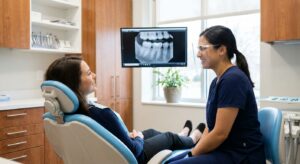

Looking for restorative care in Charlotte that your Aetna dental plan treats as in network? Moores Chapel Dentistry is in network with Aetna, and restorative dentistry is part of the care offered there, including dental fillings, dental bonding, gum disease treatment, and emergency dental care. Seeing an in-network dentist means the practice bills at fees agreed with Aetna, the office can submit claims for you, and your share is figured from your own plan’s deductible, coinsurance, and annual maximum. The rest of this article explains how that arrangement works, how plans tend to treat common restorative work, where restorative and cosmetic care overlap, and what to confirm before treatment so your costs make sense.
Understand in-network status
A dentist who is in network with Aetna has a contract to charge negotiated, predetermined fees for covered services. You typically pay less out of pocket than you would with a dentist outside the network, because the starting price for every calculation is the contracted fee rather than the office’s full fee. That arrangement also tends to simplify billing, which can take some of the worry out of wondering what you will owe.
There is one detail that is easy to miss. “Aetna” is not a single plan. Employers, federal programs, and individual policies all offer different Aetna dental products, and network contracts can differ by product. So the most useful question is not “Do you take Aetna?” but “Are you in network with my specific Aetna plan?” Moores Chapel Dentistry’s front desk can check your plan before your visit.
In-network vs out-of-network
In-network dentist:
- Agrees to provide covered services at rates set with Aetna
- Usually files claims directly with Aetna for you
- Typically results in lower out-of-pocket costs
Out-of-network dentist:
- Not bound by Aetna’s negotiated fees, so charges may be higher
- You may pay up front and then wait for reimbursement
- Can make sense if you strongly prefer a particular provider, though it often costs more
If you have no dental insurance at all, you would pay for restorative treatment directly or look at payment options, which are covered later in this article. If you do have an Aetna plan, an in-network office lets you use the negotiated fees from your first visit.
Know restorative dentistry’s value
Restorative dentistry covers procedures that repair or replace damaged teeth so you can chew, speak, and stay comfortable. Many of these treatments go beyond looks. Repairing a small problem early can keep it from growing into a larger, more involved, and more expensive one.
Choosing how to repair a tooth is a clinical decision, and the profession has guidance behind it. The American Dental Association has published an evidence-based clinical practice guideline on restorative treatments for caries lesions, which addresses how dentists approach restoring teeth affected by decay. Your dentist will explain which option fits your tooth and why.
Common restorative treatments and how plans tend to treat them
Fillings: When decay forms a cavity, a filling restores the tooth after the decayed portion is removed. Fillings are among the most commonly covered restorative services because they treat a clear health problem. Dental fillings are one of the services Moores Chapel Dentistry provides. Some plans pay for tooth-colored material on back teeth at the same level as other materials, while others pay only the amount for a less costly material and leave the difference to you, so ask how your plan handles this.
Dental bonding: Bonding uses tooth-colored resin to repair chips, small fractures, or worn areas. When bonding repairs damage, plans often treat it as restorative work. When it is done only to change the shape or shade of a healthy tooth, it is usually considered cosmetic. Dental bonding is offered at Moores Chapel Dentistry.
Gum disease treatment: Healthy gums support everything else in your mouth. Gum disease is one of the conditions Moores Chapel Dentistry treats, and plans generally cover periodontal care according to the category they assign it, with frequency limits on some services.
Emergency dental care: A broken tooth or sudden pain rarely waits for a convenient time. Emergency dental care is part of the practice’s services. Your plan pays for the specific procedures performed during an emergency visit, such as an exam, x-rays, or a repair, according to the category each one falls into.
Crowns, bridges, root canals, and implants: These are larger restorative procedures, and plans often place them in a higher cost-sharing category, sometimes with waiting periods and with annual maximums that limit how much the plan will pay in a year. Implants in particular are handled very differently from plan to plan. If one of these is recommended to you, ask whether it will be done at the practice and request a written pre-treatment estimate before you begin.
When you work with an in-network office, it is usually simple to get an estimate in advance, which lets you focus on getting better rather than on paperwork.
Distinguish between restorative and cosmetic
The line between restorative and cosmetic dentistry causes a lot of confusion, because both can improve how your teeth look. The difference that matters to insurance is purpose.
- Restorative care: Repairs damage from decay, breakage, or disease.
- Cosmetic care: Improves appearance and is usually not considered necessary for health.
Moores Chapel Dentistry offers cosmetic dentistry as well, including teeth whitening, veneers, and bonding, so you can discuss both kinds of goals in one place. Insurance, however, looks at each procedure separately.
Use your coverage when function and appearance overlap
Plans commonly decline to pay for purely elective treatments such as whitening. When a treatment is needed to restore function, part of it may still be covered even if the result also looks better. A few common examples of where this comes up:
- A tooth-colored filling compared with a metal filling
- Bonding to repair a chipped edge compared with bonding to reshape a healthy tooth
- A veneer that protects badly damaged enamel compared with a veneer placed only to change color or shape
Veneers are usually treated as cosmetic. In uncommon cases where a veneer repairs real damage, a plan may consider part of the cost, but you should not count on it without a written estimate.
Always ask how a procedure will be described on the claim. If you want a cosmetic upgrade alongside necessary work, ask whether the necessary portion can be submitted to Aetna while you pay separately for the elective part.
Understand Aetna coverage details
Aetna plans vary, but most cover exams and cleanings and pay a share of restorative treatment. Your own deductible, cost-sharing levels, and annual maximum come from your plan documents, not from the dentist. Aetna’s published plan brochures show how this works in practice. The 2024 Aetna Dental brochure for federal enrollees, for example, organizes benefits by class of service and lists the limitations and conditions that apply, which is the same kind of information you should look for in your own plan materials.
Key factors to review
Annual maximum: Most plans cap what they will pay in a plan year. If your treatment is extensive, you may need to plan work across two plan years or budget for what remains after the cap.
Waiting periods: Some plans require a waiting period before covering certain restorative services. Check whether yours does, especially if your coverage is new.
Deductible and cost sharing: You often pay a deductible before the plan starts paying, and then a percentage or copay for each service. Knowing these numbers ahead of time prevents surprises.
Frequency limits: Plans often limit how often certain services are covered, such as cleanings, x-rays, or replacement of a filling or crown within a set period.
Network confirmation: Use Aetna’s online directory or ask the office directly to confirm the practice is in network for your plan.
Medical plans with dental pieces
Some people carry an Aetna medical plan and assume it includes dental care. Usually dental benefits are a separate plan. Some Aetna medical products describe limited dental-related benefits in their own documents, as the OPM brochure for the Aetna HealthFund HDHP and Aetna Direct Plan does for federal members, but those benefits are defined narrowly. Read your medical plan’s brochure before assuming it will pay for a filling or other restorative work.
Aetna Dental Savings Plans
Aetna also sells dental savings plans, which are different from insurance. For a fee, you get reduced prices from participating dentists and pay the discounted fee at the time of service.
- No claim forms or reimbursement
- Discounts vary by plan and location
- You pay the full discounted fee yourself
- They are not insurance plans
If you use a savings plan rather than insurance, confirm that the dentist participates in that specific savings program, since participation in an insurance network does not automatically mean participation in a discount program.
Choose the right in-network provider
Picking an in-network restorative dentist with Aetna involves more than matching a logo on your card. You also want a practice where you feel comfortable asking questions, whether your concerns are about cost, nerves, or simply understanding what is happening.
Moores Chapel Dentistry describes its approach as personalized, compassionate care in a welcoming environment, and as a family dentistry practice it sees patients of all ages for both routine and emergency needs. Tools on file at the practice, such as digital x-rays and an intraoral camera, can help you see what your dentist sees, which makes it easier to understand why a repair is recommended.
Questions to ask before treatment
- Is the practice in network with my specific Aetna plan?
- What is my deductible, and how much of it have I met this year?
- How much of my annual maximum is left?
- Is a pre-treatment estimate recommended for this procedure?
- Will the office file the claim with Aetna for me?
- Is any part of my treatment considered cosmetic, and how will that be billed?
These questions help you understand your share before you start a treatment plan.
Prepare for out-of-pocket costs
Exams and cleanings are often well covered, while restorative work usually involves some cost sharing. Material upgrades and cosmetic changes may not be covered at all. Budgeting ahead helps you complete treatment without long pauses that could let a problem worsen.
Evaluate your restorative options carefully
If you are choosing between more than one way to fix a problem, ask about both the clinical tradeoffs and the coverage differences. A less expensive option can help your finances now, while a more durable option may cost less over time. Request a breakdown that shows the fee, what Aetna is expected to pay, and what you are expected to pay for each choice. A small repair such as bonding may be all you need in some situations, and your dentist can tell you when that is reasonable.
Keeping up with preventive care, including routine exams and cleanings, fluoride, and sealants for eligible patients, also makes a difference. Catching decay or gum problems early often means a simpler repair.
Use financial strategies to supplement coverage
Even good coverage leaves you with some costs. If paying all at once is hard, these approaches can help you keep needed work on schedule.
Payment options
- Office payment arrangements: Ask the practice whether any payment options are available for larger treatment plans.
- Health savings accounts (HSAs): If you have a qualifying high-deductible health plan, you may be able to use HSA funds for eligible dental expenses.
- Flexible spending accounts (FSAs): If your employer offers an FSA, you can set aside pre-tax dollars for out-of-pocket dental costs.
- Third-party healthcare financing: Some patients use healthcare credit products. Read the terms carefully, especially any promotional period.
Plan-based strategies
- Timing treatment across plan years: If your annual maximum is a limit, splitting non-urgent work across plan years may let you use two years of benefits. Do not delay treatment your dentist considers urgent.
- Coordinating secondary coverage: If you are also covered under a spouse’s dental plan, ask which plan is primary and how the second plan pays.
- Using pre-treatment estimates: For larger procedures, a pre-treatment estimate gives you a written picture of what Aetna expects to pay.
Take practical steps toward a healthier smile
Aetna in-network status can make restorative care easier to plan, from fillings and bonding to gum disease treatment and emergency repairs. A clear plan and early treatment usually keep both the work and the cost more manageable.
Outline your next steps
Confirm your network status:
- Make sure the practice is in network with your exact Aetna plan
- Ask which restorative services are provided at the practice
Review your benefits:
- Look up your deductible, cost sharing, annual maximum, and any waiting periods
- Ask whether a pre-treatment estimate makes sense for larger work
Discuss your goals with your dentist:
- Identify which teeth need attention first
- Ask whether any cosmetic goals overlap with necessary repairs
Plan your timing:
- Schedule urgent care promptly
- Decide whether spreading non-urgent work across plan years helps your budget
If you also want cosmetic changes such as teeth whitening or veneers, expect those to be priced separately from what Aetna covers, and ask for a written estimate so you can decide with the full picture in front of you.