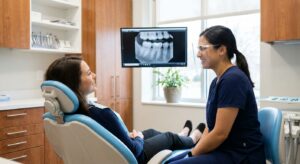

If you need a Cigna in-network emergency dentist in Charlotte, Moores Chapel Dentistry is a family practice that participates in the Cigna network and provides emergency dental care. Seeing a Cigna in-network emergency dentist usually lowers what you pay, because the office has agreed to Cigna’s contracted fees. Your share still depends on your plan type, your deductible, and which benefit category the treatment falls into. Before your visit, confirm that the office participates in your specific Cigna plan. Then check your remaining annual maximum and ask whether any procedure needs preauthorization. This guide explains how Cigna handles urgent dental care, what counts as an emergency, how Cigna Medicare Advantage dental benefits fit in, and how to get through the visit without billing surprises.
What Does “In-Network” Mean for Cigna Emergency Dental Care?
In-network providers have a contract with Cigna to deliver services at negotiated rates. When you visit a participating dentist for urgent care, your copays or coinsurance are calculated from those lower contracted fees. Out-of-network dentists have not agreed to Cigna’s fee schedule, so they may charge their full fee. Cigna then pays according to its out-of-network rules, and you may be billed for the difference.
The practical benefits of choosing an in-network office during an emergency include:
- Lower out-of-pocket costs, because coinsurance is based on discounted fees
- An office that already works with Cigna’s copay and coinsurance terms
- Less risk of balance billing for urgent procedures
- Claims filed by the office directly, which usually means simpler processing
At Moores Chapel Dentistry, Cigna is one of three confirmed in-network carriers, along with Aetna and Delta Dental. The practice also accepts many other plans, including Ameritas, Assurant, Blue Cross Blue Shield, Humana, Medicaid, MetLife, Mutual of Omaha, Principal, TeamCare, TruAssure, United Concordia, UnitedHealthcare, and Unum. Accepting a plan is not the same as being in network with it. For Cigna members specifically, the in-network relationship is what keeps your costs lower.
What Counts as a Dental Emergency?
Emergency dentistry covers conditions that threaten your health or could cause lasting damage if they go untreated. There is no single universal definition. A scoping review of dental emergency literature published through the NIH found that the term is defined inconsistently across studies and settings. That is one reason your Cigna plan documents matter: they describe how your plan classifies urgent care.
In general, situations treated as dental emergencies include:
- Severe toothaches that may signal an abscess or deep infection
- Injuries such as knocked-out, loosened, or fractured teeth
- Infections causing facial swelling, pus, or fever
- Bleeding that will not stop
- Situations where a tooth may need to come out urgently
Which common problems bring patients in?
- Severe tooth pain, swelling, or pus. These often point to infection and should be evaluated quickly.
- Cracked or chipped teeth. Accidents and hard foods are common causes. A small chip may be repaired with dental bonding or a filling. A larger break may need more extensive restorative work.
- Broken tooth fragments. A broken tooth can affect chewing, cut your tongue or cheek, or expose the inner tooth to bacteria.
- Loosened or displaced teeth. Falls and sports injuries can shift teeth out of position.
For first-aid steps while you arrange care, such as handling a knocked-out tooth, the ADA’s consumer site, MouthHealthy, publishes guidance on common dental emergencies.
When should you go to a hospital instead of a dentist?
If swelling spreads toward your eye or neck, or if you have trouble breathing or swallowing, seek emergency medical care right away. The same applies to a jaw injury from serious trauma. A dental office can treat the tooth, but airway and serious medical concerns come first. Your medical plan, not your dental plan, generally handles hospital emergency room visits.
How Does Cigna Pay for Urgent Dental Treatment?
Cigna does not pay more or less because a visit was an emergency. It pays according to the category each service belongs to in your plan. A typical emergency visit has several parts, and each one is billed separately:
- The emergency or limited exam. Many plans classify this as diagnostic care.
- X-rays. Usually diagnostic. Moores Chapel Dentistry uses digital X-rays and an intraoral camera, which help show the problem and document it for your claim.
- Palliative treatment. Some plans cover a visit focused only on relieving pain.
- Definitive treatment. Fillings, bonding, and other restorative care fall into basic or major categories, usually after the deductible.
Do urgent surgical procedures get covered?
When a tooth cannot be saved, extraction or other surgery may be needed. Cigna plans commonly cover medically necessary oral surgery as a basic or major service, subject to your deductible and coinsurance. Some plans require preauthorization for surgical procedures, sedation, or care delivered in a hospital. If your situation calls for a specialist, ask whether that oral surgeon is also in Cigna’s network for your plan.
Is pain relief covered?
Local anesthesia given during a procedure is usually part of the treatment itself. Prescription drug coverage is a separate matter. Pain or antibiotic medication your dentist prescribes is typically filled at a pharmacy and processed through your medical plan’s prescription drug benefit, not your dental plan. Sedation for anxiety or complex procedures may be covered only in certain circumstances. Check your plan or ask about preauthorization.
Which Cigna Dental Plan Types Exist, and How Do They Handle Emergencies?
Cigna offers several dental plan designs. Its own open enrollment materials describe options such as a dental HMO (DHMO) and a dental PPO (DPPO). The details vary by employer and plan year, so treat this table as a general guide:
| Plan type | Network requirement | How emergencies are generally handled |
|---|---|---|
| DPPO | You can see any dentist, but in-network costs less | Paid by service category at the in-network level when you use a participating dentist |
| DHMO | You usually select a network general dentist | Often handled through a fixed patient charge schedule; out-of-network care may be limited to defined emergencies |
| DPOS | Hybrid of network and out-of-network options | Lower costs in network, higher out of network |
| Indemnity | No network restrictions | Freedom to choose, typically with higher out-of-pocket costs |
Your exact copays and coinsurance appear in your plan’s summary of benefits or fee schedule. If you are on a DHMO, check whether you must see your assigned dentist for emergencies. Some DHMOs require that, while others allow emergency care elsewhere under limited conditions.
Do Cigna Medicare Advantage Plans Cover Emergency Dental Care?
Original Medicare (Part A and Part B) generally does not cover routine dental care such as exams, fillings, or extractions. Many people who are eligible for Medicare get dental benefits through a Medicare Advantage plan (Part C). These plans often bundle extra benefits like dental, vision, and hearing, and many include Part D prescription drug coverage.
If you have a Cigna Medicare Advantage plan, keep these points in mind:
- Dental benefits differ widely between advantage plans. Some cover only preventive care. Others include basic or comprehensive services, sometimes with a separate dental network.
- The dental network may not match the medical network. Confirm that the dental office is listed for your specific Medicare Advantage plan, not only for Cigna commercial plans.
- Annual limits may be lower. Many Medicare Advantage dental benefits carry an annual dollar cap.
- Prescriptions follow your drug coverage. Medication prescribed after an emergency visit is processed under your plan’s Part D prescription drug benefit, if your plan includes one.
Moores Chapel Dentistry’s confirmed in-network status applies to Cigna. To learn whether your particular Medicare Advantage dental benefit is accepted, call the member services number on your Cigna card and ask the office to verify your plan.
How Do You Find a Cigna In-Network Emergency Dentist in Charlotte?
Use the Cigna directory
Start with the provider search in your Cigna online account or app. Enter your plan, your ZIP code, and any relevant filters. The results show participating providers near you with contact details. Moores Chapel Dentistry serves patients in Charlotte, Arlington, Belmont, and Paw Creek.
How do you confirm a dentist is still in network?
Networks change, so double-check before you book:
- Ask the dental office whether it participates in your exact Cigna plan, not just “Cigna”
- Review the provider’s listing in your online Cigna account
- Call the member number on your Cigna ID card if anything is unclear
What questions should you ask before the visit?
- Do you participate in my specific Cigna plan and network?
- Can you check my remaining annual maximum and deductible?
- What is my estimated share for an emergency exam and X-rays?
- Will any likely treatment require preauthorization?
- If I need a specialist, can you refer me to one who is in my Cigna network?
What Will You Pay, and How Can You Keep Costs Down?
How do deductibles and annual maximums work?
Most Cigna dental plans have a deductible that applies to basic and major services. Diagnostic and preventive services are often exempt. Dental plans also typically have an annual maximum, which is the most the plan will pay in a benefit year. This works differently from a medical out-of-pocket maximum. Once a dental plan reaches its annual maximum, you usually pay the remaining costs yourself until the plan year resets. If an emergency happens late in the year after other major work, check how much of your maximum is left.
Ways to lower your costs
- Stay in network to keep contracted fees
- Ask for a pre-treatment estimate for any non-urgent follow-up work
- Confirm preauthorization requirements before scheduled procedures
- Schedule follow-up care in a later plan year only if it is truly safe to wait, and ask your dentist first
- Keep up with routine exams and cleanings, which can catch problems before they become emergencies
That last point fits how Moores Chapel Dentistry approaches care. As a family practice offering preventive, restorative, and emergency dentistry in one place, it can often handle the follow-up to an emergency visit, such as a filling or bonding, without sending you elsewhere.
How Do Claims, Preauthorization, and Appeals Work?
When is preauthorization needed?
Some procedures may need approval for full benefits. Check your plan documents or ask Cigna whether:
- Surgical extractions need prior approval
- Sedation or general anesthesia must be pre-certified
- Hospital-based dental care is covered
In a true emergency, treatment to relieve pain or infection usually comes first. The office can tell you which follow-up steps may need approval.
What if you see an out-of-network dentist?
If you visit a non-participating dentist, you may have to pay up front and file the claim yourself:
- Get an itemized receipt with procedure codes
- Complete Cigna’s claim form with patient and provider details
- Submit it by mail or through your online account
- Track the claim through your member account
Out-of-network reimbursement may come with higher costs, and the dentist may bill you for amounts above Cigna’s allowance.
What if a claim is denied?
- Read the explanation of benefits and denial letter for the reason
- Contact Cigna member services for clarification
- Ask your dentist for supporting documentation, such as X-rays or clinical notes
- File an appeal within the deadline your plan specifies
How Should You Prepare for an Emergency Dental Visit?
- Bring your Cigna ID card and a photo ID
- List your medications, allergies, and any recent dental work
- Note when the pain or injury started and what makes it better or worse
- If a tooth was knocked out or broken, bring the tooth or pieces as advised by first-aid guidance
- Arrive a little early to finish paperwork
Where Can You Find More Support?
- Your Cigna online account shows claims, benefits, remaining maximums, and participating providers
- Check whether your plan offers a nurse line or telehealth service for advice before you can be seen
- The American Dental Association and the National Institute of Dental and Craniofacial Research publish general information on oral health conditions
When you know how your Cigna plan classifies each service, a dental emergency becomes much easier to manage. Learn the signs of a true emergency and choose a Cigna in-network emergency dentist in Charlotte. Confirm your benefits as early as you can, so you can focus on relief rather than on surprise bills.